
Philosophy and Artificial Intelligence. Does AI Help Us Think or Stop doing it?

Astrea Nicodemo
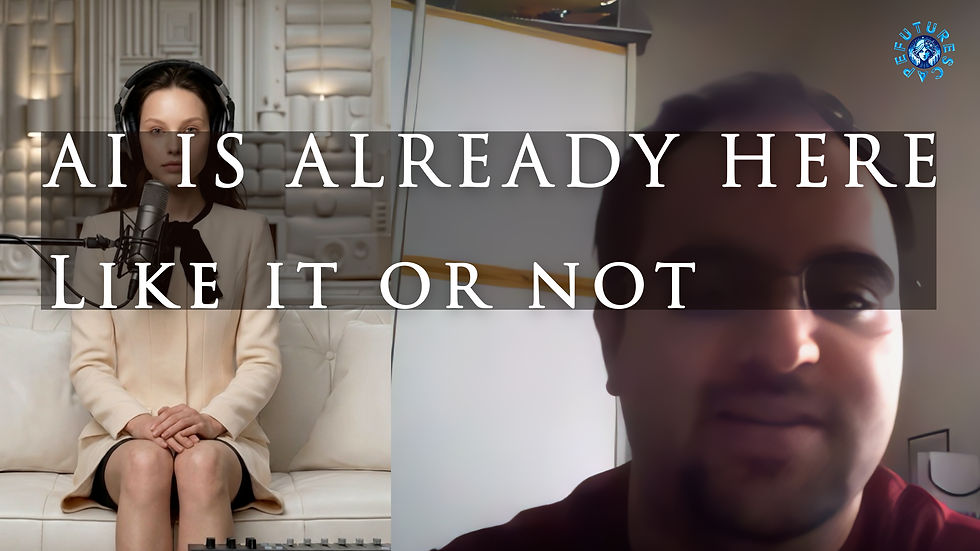
AI, chess and critical thinking. Lyria interviews Lorenzo Della Peruta
Artificial intelligence forces us to ask what we want to keep doing and what we want to delegate to it instead.
In this new episode of FutureScape Podcast, Lyria meets Lorenzo Della Peruta: philosopher, writer, and chess champion. The conversation spans philosophy, language, critical thinking, chess, and artificial intelligence to get to the central question of today’s topic, namely whether technology helps us think better or whether, on the other hand, it risks getting us used to stopping doing so.
The answer is by no means obvious.
What can philosophy offer in the age of artificial intelligence?
We live in an era dominated by speed.
Content is consumed in seconds. Opinions translate into immediate reactions. Algorithms choose what to show us before we even know what to look for.
In such a world, philosophy can seem slow, ancient, almost obsolete.
And yet, this is precisely what makes it indispensable.
Philosophy, as a method of creating distance from instinctive reaction, is a space “of the soul” where we can contextualize what is happening, question the tools we use, and ask ourselves whether what we call progress is really expanding our humanity or quietly shrinking it.
The exponential development of Artificial Intelligence makes this question even more necessary.
Because AI not only generates texts, images, answers and predictions, it forces us to ask ourselves what intelligence is, how human thought works, what the boundaries of creativity are and what forms of judgment we should never delegate to synthetic intelligence for any reason.
Does AI help us think, or does it get us used to delegating?
Artificial intelligence can be a very powerful tool.
It can help us do research, organize information, compare points of view, improve a text, stimulate an idea, provide us with a perspective that we would not have considered on our own.
But the risk exists.
If we use AI before we have built our own expertise, we can confuse the fluidity of an answer with knowledge. We can receive convincing words without really understanding the foundations on which they rest. We can start to depend on an external system not only to obtain information, but also to orient, decide and judge, without having the necessary skills to understand if we can trust the answers obtained.
The point, then, is not whether artificial intelligence is useful.
The point is whether we know how to use it with full knowledge of the facts.
Are we sure that we are still able to read, interpret and decide with our heads?
For FutureScape, this is one of the essential questions of our time. It is not a question of whether or not we reject artificial intelligence, but of understanding whether we are able to use it without giving it what makes our thinking meaningful.
Chess, AI and human thought: who will really make the next move?
The interview becomes particularly fascinating when Lorenzo talks about chess.
Chess has always been associated with intelligence, strategy, calculation, intuition, and discipline. It is a game invented by humans, refined by humans, loved by humans.
Then the machines beat us on the field.
The symbolic moment came in 1997, when Deep Blue defeated Garry Kasparov. Since then, chess engines have transformed the way players study, train, and understand the game. Today, a computer can analyze a location and point out the best moves with a depth that no human mind can reach.
At first glance, it might seem like a defeat.
If a machine can calculate better than the best human champion, what makes human intelligence still so special?
Lorenzo’s answer is subtle.
We continue to watch chess tournaments between human beings. Computer tournaments exist, but they do not fascinate us in the same way. Because what interests us is not only who wins, but also how that move is reached: the tension, the uncertainty, the risk, the style, the personal story behind the decision.
The machine can know the best move.
But it is the human being who gives meaning to the match.
What does chess teach us about the future of work and creativity?
Chess is a powerful metaphor for many other fields that are affected by artificial intelligence today.
When a machine becomes better than us at a specific task, our role changes. It doesn’t mean that it necessarily has to disappear, but that it has to be redefined.
In chess, calculation engines have not destroyed interest in the game played by humans. They have changed preparation, analysis, training, and interpretation. They have raised the overall bar. They have given players new tools.
As we have seen, the game played between human beings continues to interest us because it contains something that the machine does not completely replace, like vulnerability, choice, pressure, identity, the way a person inhabits risk.
This explanation could be very useful and could also be applied outside of chess.
In fact, it is not just a matter of establishing whether AI is able to produce a result, but of understanding what human presence remains necessary in order to obtain that result and, subsequently, how to use it.
We need to find out who asks the question, decides what matters, takes responsibility, interprets the answer, and understands the consequences.
The real risk is not automating. It is delegating without awareness.
Lorenzo introduces an important distinction.
Humans have always lost some skills when new technologies have made them less necessary. Many of us no longer remember phone numbers. Many orient themselves less without digital maps. Very few would know how to start a fire without tools.
Not every lost ability is a tragedy.
We must therefore ask ourselves which abilities we can replace without deeply damaging ourselves and which, on the other hand, would produce devastating side effects if abandoned.
Critical judgment belongs to the second category.
Knowing how to think for oneself, interpreting a book, questioning a source, choosing the destination of one’s journey, and understanding what we really want, are not secondary functions. They are an intrinsic part of freedom.
Because when we completely delegate our thoughts, we not only lose autonomy; we risk living according to ideas, conditions, and limits we have not chosen.
Can artificial intelligence help us understand ourselves?
One of the most philosophically interesting aspects of artificial intelligence is that it forces us to look in the mirror.
AI or LLM systems are trained using the language, culture, knowledge, mistakes, biases, and imagination of human beings. What they produce is not disconnected from us. It is, in large part, an elaboration of what we have already created.
This is why artificial intelligence is not just a technological issue.
It is a philosophical event.
It forces us to return to reflect on old issues under new pressure.
Consciousness, intelligence, creativity, and originality are all riddles related to the concept of Human Nature that we have not yet been able to solve.
What kind of future do we face when our instruments begin to resemble our thoughts?
Because we need lucidity, not fear or blind enthusiasm
Artificial intelligence is already part of our world, now, not in the distant future.
It is, in fact, already everywhere, even if we do not see it: in work, in images, in conversations, in training, in creative processes and in social structures.
The choice is not between fear and blind enthusiasm in adoption, but between lucidity and short-sightedness in use.
Will we remain lucid enough to use AI as a tool and not as an oracle?
Lucid enough to remember that thinking is not just a cognitive function. Thinking is freedom.
Conclusion: The next move is still ours
The future of artificial intelligence will not be decided only by engineers, investors, companies, governments, or machines.
It will also be decided by the quality of the questions we can ask.
That is why the dialogue between philosophy and AI matters. Philosophy does not give us quick answers. It teaches us to stay inside the question long enough to understand what is really at stake.
And perhaps this is also the lesson of chess. The machine can calculate the best move, but the meaning of the game still depends on the human being who decides how to play.
At least for now!
Watch the new FutureScape interview with Lorenzo Della Peruta on Youtube, if you want to learn more about one of the most pressing questions of our time:
Can artificial intelligence help us think more deeply without leading us to stop thinking for ourselves?
Article: Astrea Nicodemo
Translation: Astrea Nicodemo
Images & Video: Eretikos Art
Featured Expert: Lorenzo Della Peruta
Art Direction and subject: Barbara Foz
The views expressed by Lorenzo Della Peruta in this interview are personal and reflect only his own perspective. They do not necessarily represent the official views of FutureScape, Astrea Nicodemo, or the channel. FutureScape provides a space for dialogue, reflection, and critical discussion on artificial intelligence, society, and the future.
People also ask
Can artificial intelligence replace human thinking?
Artificial intelligence can automate many cognitive functions, help with research, generate content, and analyse information very quickly. But replacing human thought entirely would mean delegating judgment, responsibility, interpretation and values. The risk is not using AI, but using it without awareness.
What can philosophy offer in the age of AI?
Philosophy helps to investigate the meaning, limits and consequences of artificial intelligence. It asks not only what AI can do, but also how it changes our understanding of human intelligence, freedom, consciousness, creativity, and responsibility.
Why is chess important to understanding AI?
Chess is one of the symbolic fields in which machines have surpassed human champions. From Deep Blue to modern chess engines, AI has transformed the way we study and analyse the game. But chess played by humans remains fascinating because we are not only interested in the best move: we are interested in the personal story behind that move.
Can AI weaken critical thinking?
AI can weaken critical thinking if we accept its answers without verification or use it as a substitute for our own judgment.
What remains human when machines calculate better than we do?
It remains human not only to find an answer, but to give it meaning: to make choices, to take responsibility and to understand why something really matters.
© 2026 FutureScape, a project by Astrea Nicodemo. All rights reserved. All original text, images, and video content published herein are protected by copyright. Unauthorized reproduction is prohibited.
Some visual materials may be created or enhanced using artificial intelligence tools under human creative direction.
Comments